Posts

Blood supply to the Kidneys

Image
BLOOD SUPPLY TO THE KIDNEYS Fig.1   Each kidney receives blood supply from the Renal Artery.  The Renal Artery (See Fig.1) arises directly from the aorta (the main trunk that carries blood from the heart).  After the blood has flown through the kidney tissue, the venules unite to form the renal vein that directly drains into the Inferior Vena Cava (the main trunk that carries blood towards the heart).  Each Kidney has normally one renal artery and one renal vein.  Sometimes there can be an additional smaller renal artery supplying the upper pole or the lower pole of the kidney.  Rarely, there can be more than one renal vein. The main renal artery soon divides into the segmental artery that continues as an interlobar artery.  Interlobar artery branches to form interlobular artery which finally forms the arcuate artery.  The arcuate gives rise to afferent arteriole that forms the capillary tuft called ...
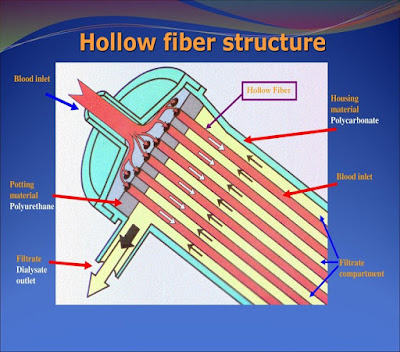
DIALYSIS CONSUMABLES - TECHNICAL EXPLANATIONS

Image
      Dialysis Consumables       Technical Specifications         1)   Hollow fiber dialyzer               The dialyzer is also called an Artificial Kidney comprised of 2 compartments namely a Blood compartment & dialysate compartment.  The blood compartment has tiny hollow fiber membranes open from both ends meant to carry blood from one end to the other enabling toxic waste & fluid from the blood to get pumped out into the dialysate compartment.  The gap between these open ends of hollow fiber membranes are fused by using potting material Polyurethane so that blood will just enter hollow fiber membrane and not in between the spaces causing blood leak into the dialysate compartment. Dialysate compartment OR filtrate compartment, as shown in the image, is the empty space surrounding these hollow fiber membranes placed in a cylindrical body made up of polyc...

IMPORTANCE OF THE WATER TREATMENT (REVERSE OSMOSIS) PLANT IN DIALYSIS SET UP

Image
Importance of the Water Treatment (Reverse Osmosis) plant in dialysis set up Watch:  PRE-TREATMENT ELEMENTS Watch:  RO TREATMENT & POST-TREATMENT ELEMENTS Watch:  WATER CONTAMINANTS & POTENTIAL CLINICAL SYMPTOMS Introduction: An average person drinks 14L of water per week. Water arriving at faucets is acceptable for drinking but not acceptable for HD. It contains various contaminants such as chlorides, chloramines, fluorides, etc. Healthy kidneys are capable of extracting and excreating those contaminants. However, the same water may not be suitable for dialysis purposes since more than 90% of dialysate used in the machine is water. A dialysis patient will be exposed to 300L of water per week. Hence, if the water used for dialysis is not ultrapure it leads to potential clinical symptoms and complications. Possible water contaminants Symptom Watch here :  Water contaminants & potential clinical symptoms Water contaminants are a result ...

PLANNED PREVENTIVE MAINTENANCE PPM.

Image
PLANNED PREVENTIVE MAINTENANCE PPM. Maintenance is the act of getting equipment to be functional, available and reliable in this case our dialysis machine. PPM involves daily inspections, cleaning, fine-tuning and adjustment of equipment to keep the machine in good condition.  It is regular repetitive work done to keep the machine working.  In this case, the operator is also the maintenance person engaged in PPM activities. The attitude of the user is that he/she has all business with the maintenance of the dialysis machine unlike in Corrective maintenance where the user has no business with even simple maintenance activities like cleaning but stick strictly to only machine operations. Common language heard is that it’s not my work. The attitude in corrective maintenance is that I operate to breakdown and the maintenance personnel has to fix it, ‘I have no business with maintenance’. It’s such a rude statement but unfortunately, this happens often.  Esprit de...